Where does curiosity go next?
The talent is here. The ambition is here. For many young people, the path into real space capability is still difficult to see.
Building a space economy also means building the people who can take part in it.
FALAK SIMLAB · REAL-PHYSICS SPACEFLIGHT SIMULATOR + AI TUTOR · LIFELONG LEARNER RECORD · EN + العربية
ENGINE LIVE · ... ADAPTATION DECISIONS RECORDED · SEE THE DATA ↗
SCROLL
A space academy that teaches by letting learners fly.
SimLab runs real-physics space missions in the browser, in English and Arabic. Learners design the rocket, choose the orbit and fly the launch. An adaptive teaching engine watches every decision, works out which concept a mistake points to, and changes the support for that learner. A concept only counts as learned when they later get a fresh question on it right without help.

- The learner makes an engineering decision.
- The simulation computes what it does to the flight.
- The teaching engine finds the concept behind the mistake.
- S.O.C.R.A.T.E.S. asks about that concept, then checks it again later.
A real physics flight. Your control inputs decide what happens.
Flight-controller agents watch dynamics, airframe stress and comms, and call out events live in the mission feed.
S.O.C.R.A.T.E.S. turns each callout into a question about why, not just what. Learners answer by voice, and a proven concept earns the hardest test: teach it back.
One mastery record per concept, carried across missions and built to persist for years. It decays on each learner's own forgetting curve: it remembers how they think, not just what they scored.
Before a learner stumbles, the engine already knows which concept is risky for them: a check lands early, the crew debates the call, or the cadet asks to be taught.
On every debrief the learner sees their own mind: each concept a star whose brightness is live mastery, fading as memory decays, amber where trouble is predicted. Tap one to read the record behind it.
WHERE PILOTS STALL · FIRST TRY
HOW THE ENGINE ANSWERS
 THE DECISION
THE CONSEQUENCE
THE TEACHING
OBSERVE
COACH
ADAPT · LIVE
One action travels the whole loop. The system sees it, the tutor asks about it, and what comes next changes because of it.
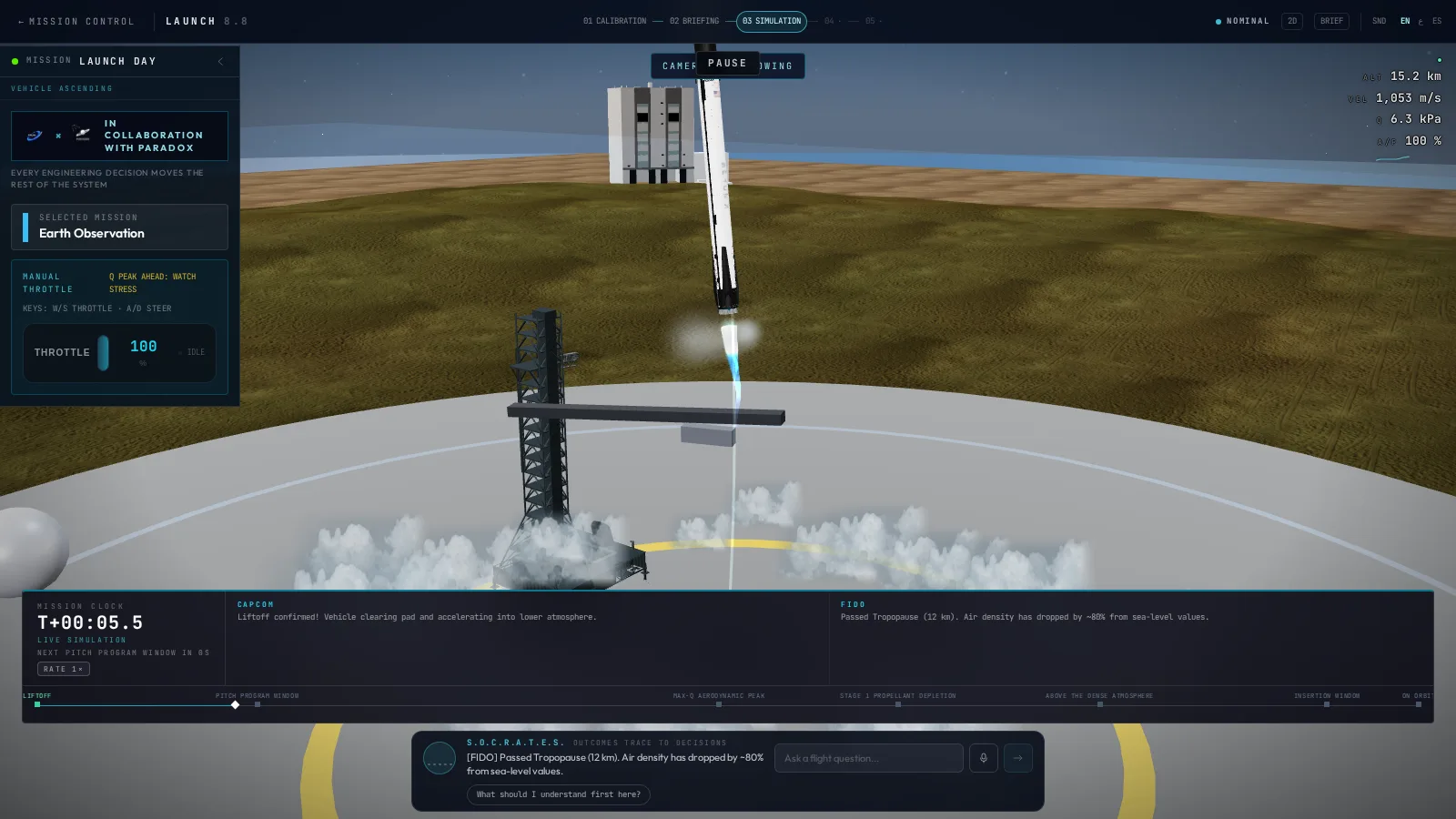
Watch a decision become a flight, and a flight become a lesson.
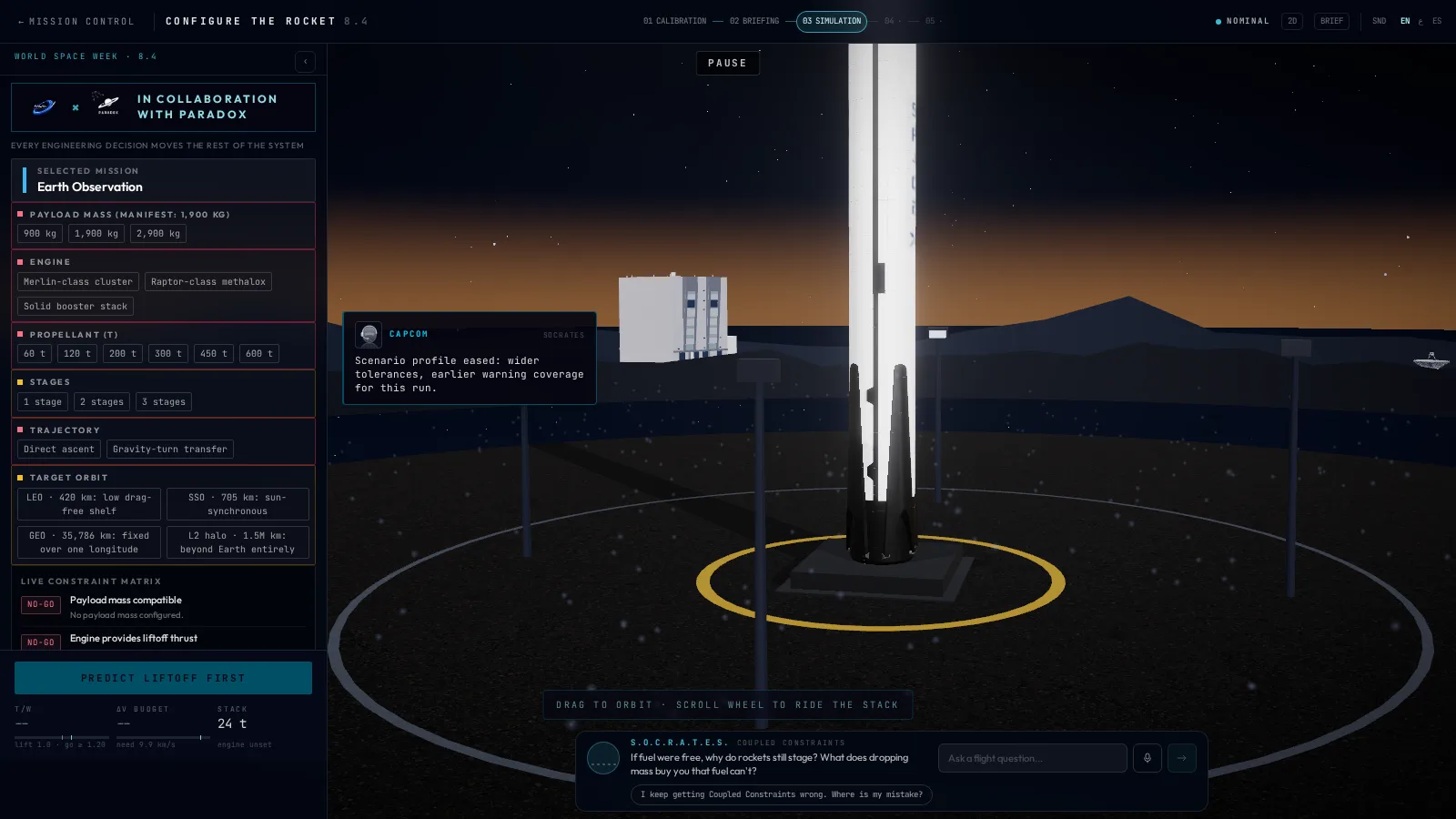
Mission 8.4, Engine and Propellant. The learner chooses the engine for the rocket they designed in earlier missions. Nothing is pre-scripted: thrust, mass and propellant feed straight into the flight model.
Mission 8.8, Launch. The same choices now fly. An underpowered engine or the wrong orbit shows up as real physics: slower climb, higher drag loads, a missed target. The learner sees why, not just a score.
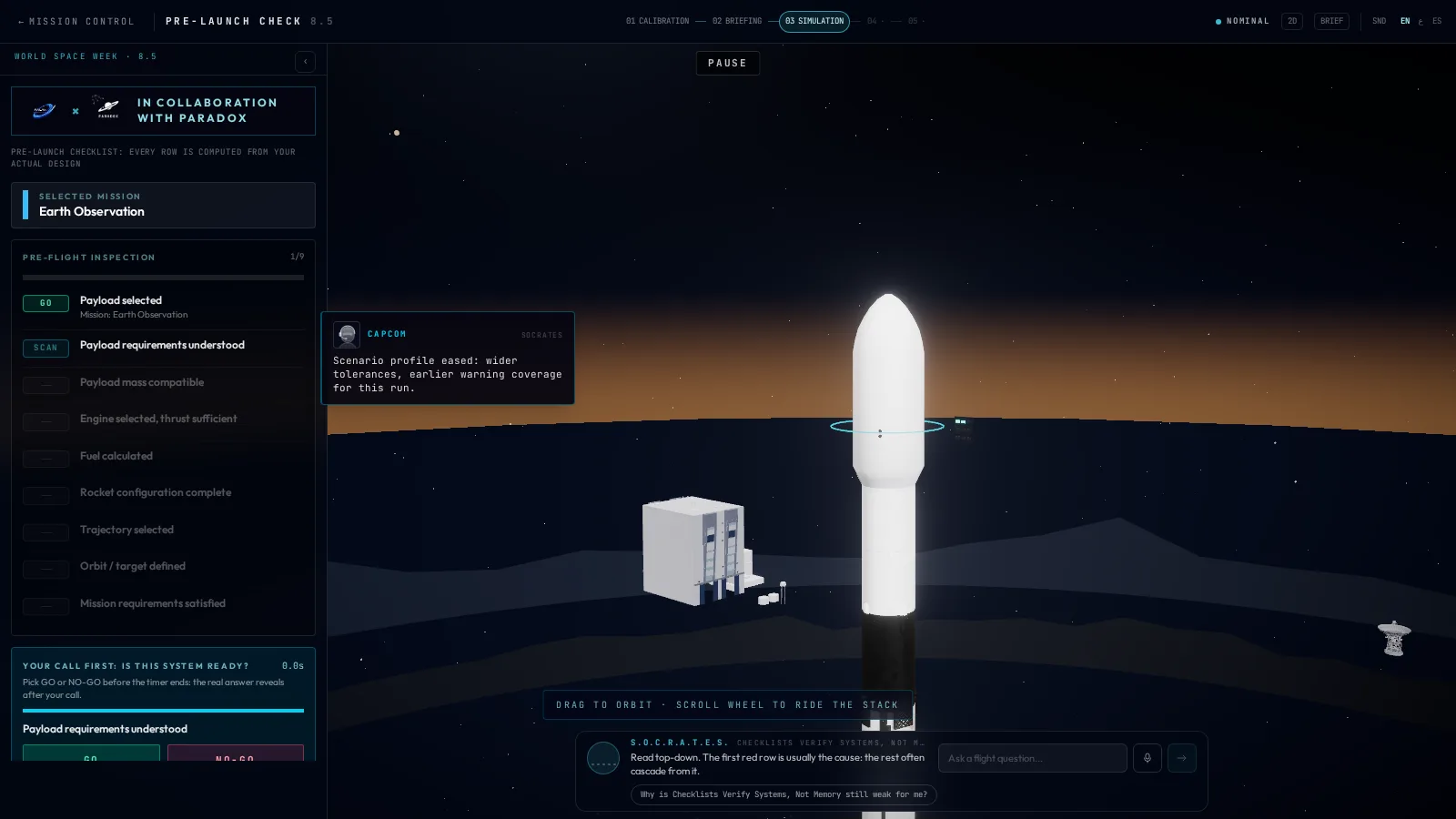
Mission 8.5, Pre-Launch Check. The teaching engine has noticed where this learner struggles. CAPCOM explains how the scenario adapted, and S.O.C.R.A.T.E.S. asks a question about that learner's weak concept, not a canned line. A concept only counts as learned when the learner later answers a fresh question on it without help.
The first cohort flew with the Paradox Team.
 Paradox TeamOFFICIAL FALAK PARTNER FOR EGYPT · LINKEDIN ↗
What it shows. Learners finished every session they started, and every answer was logged on the server per concept, so an instructor can see exactly where a class struggled.
What it does not show yet. The accuracy range is descriptive, measured across different missions with no control group, so it is not a measured learning gain. Every new institutional pilot adds a baseline and a follow-up check so gains can be measured properly.
A crew watches the learner fly. Not a chatbot on the side.
Flight-controller agents read the same telemetry the learner does: altitude, pressure, fuel, decisions. They call out what matters as it happens. S.O.C.R.A.T.E.S. orchestrates them and asks the question underneath each call: not what happened, but why it happened to your rocket. Every committed answer banks as evidence: streaks, rank and mastery move because the learner did something. When a failure repeats, the tutor briefs with the learner's own numbers: throttle average, Max-Q, airframe integrity. And after every flight the engine fits a control model of the pilot (reaction time, correction strength, hunting or smooth) and the crew hands back a debrief a kid can read, in English or Arabic. Misconceptions stay on file until they are actually closed.
Space is not one profession.
It is a system of people making one mission possible.
Select a discipline. The mission at the centre stays the same; the route into it changes.


SimLab with the eight-mission World Space Week suite, live physics, the S.O.C.R.A.T.E.S. tutor and crew, English and Arabic, and an educator console.
Separate tracking of independent and assisted answers, tutor moves linked to their outcomes, and cohort records for signed-in classes.
More sections and disciplines, university and agency programmes, and measured learning-gain studies with partners.
Aerospace and defence training applications, and in 10 to 15 years a physical FALAk space company. Neither is offered today.
“Humans yearn to achieve greatness and to build. I have always wanted to help the future: to help the lesser become the better, and the greater.”
 FOUNDER'S NOTE · ADHAM FOUAD
Space should not remain something young people only watch from a distance.
WORLD SPACE WEEK PILOT COMPLETE · OCT 6–7 · NEW COHORTS VIA YOUR SCHOOL
What is FALAk SimLab?
A browser-based space flight simulator and adaptive learning platform. You fly real missions while an AI tutor, S.O.C.R.A.T.E.S., models what you understand and adapts what comes next. One mastery record per concept persists between missions, so the platform remembers how you think, not just what you scored. English and Arabic, no installs.
Who is it for?
Learners join through their school, a university cohort, or the individual waitlist. Schools, universities and institutions run whole cohorts with per-learner telemetry, evidence of understanding, and flight replay for educators.
Does it work in Arabic?
Yes, end to end. The interface, briefings, assessments and the tutor all operate natively in Arabic and English.
How does FALAk make money?
FALAk is a paid platform. A 30-day school pilot costs £1,500 flat for up to 300 seats and is credited toward the first annual licence (~£4,000 per school per year). Revenue is institutional: school and university licences for cohorts, educator consoles with flight replay, then evidence-linked pathway programmes. See pricing.
What is the long-term plan?
Education first, then deeper missions and learner-owned evidence of capability, then multidisciplinary pathways across the space economy. Over a 10 to 15 year horizon, FALAk aims to become a physical commercial space company built from the talent this pathway develops.