
The Physics of Escape
1 The Gravity Well & Delta-V
Space is not measured in distance; it is governed entirely by energy. Earth resides at the absolute bottom of a steep, unforgiving Gravity Well. Escaping it is the single greatest mechanical challenge our species undertakes.
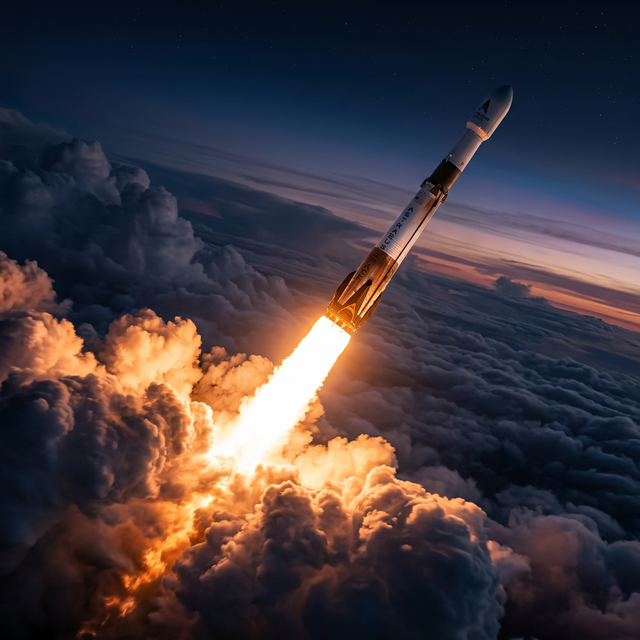 Fig 1. Fighting the Gravity Well requires immense energy and structural
resilience.
Fig 1. Fighting the Gravity Well requires immense energy and structural
resilience.
In a frictionless vacuum, conventional "miles" are irrelevant. The only currency that dictates orbital mechanics is Delta-v (Δv)—the capacity to induce a violent, sustained change in velocity. You do not simply drive to orbit; you must expend monumental propulsive energy to fundamentally rewrite your kinetic state.
- Low Earth Orbit (LEO): Requires a staggering ~9.3 km/s (33,000 km/h) of Δv to reach.
- The Moon: Requires roughly an additional +6 km/s of Δv from LEO.
- Mars: Requires roughly an additional +4.3 km/s of Δv from LEO (assuming optimal planetary alignment).
The vast majority of a launch vehicle's energy is consumed just crossing the first 400km into LEO. The old aerospace adage is true: once you are in orbit, you are halfway to anywhere in the solar system.
2 The Tyranny of the Rocket Equation
The architecture of every spacecraft in existence is subjugated by a single, ruthless mathematical truth formulated in 1903. It dictates the exact ceiling of performance a vehicle can achieve based on its mass and its propulsion system.
Try it yourself: Adjust the sliders to see how exponentially difficult it is to get more Delta-V. Notice how adding more fuel eventually stops giving you meaningful speed!
The equation hides a punishing reality: orbital mechanics are governed by logarithmic scaling. To achieve more Δv, you must carry more propellant. But propellant has immense mass. Therefore, you are forced to burn exponentially more fuel simply to lift the unburned fuel required later in the flight.
This mathematical tyranny dictates rocket design. You cannot build a spacecraft out of thick steel like a naval battleship. A modern orbital launch vehicle is little more than a gossamer-thin aluminum balloon, composed of 90% to 94% explosive propellant by mass. Barely 1% is the actual payload. Spaceflight is the art of strapping a chair to a highly-controlled detonation.
3 Staging: Throwing Away the Ship
Because of the exponential mass penalty outlined above, building a Single-Stage-To-Orbit (SSTO) vehicle using chemical propulsion borders on the impossible. The colossal tanks required to store launch fuel become parasitic dead weight the millisecond they run dry.
The brutal engineering compromise is Staging. We build rockets that intentionally destroy themselves as they ascend. When a primary booster (Stage 1) exhausts its propellant, it is instantly jettisoned. The subsequent stage (Stage 2) then ignites in the near-vacuum, entirely liberated from the metric tons of dead metal below it, achieving an instant, vital spike in mathematical efficiency.
This is why launch vehicles are vertically stacked cylinders, and why securing access to space has historically required discarding multi-million dollar hardware into the ocean after mere minutes of flight.
4 Specific Impulse (Isp) vs Thrust
Propulsion systems are governed by inescapable thermodynamic compromises. Engineers must constantly balance between two opposing forces: Thrust (raw, immediate power) and Specific Impulse (Isp) (fuel efficiency).
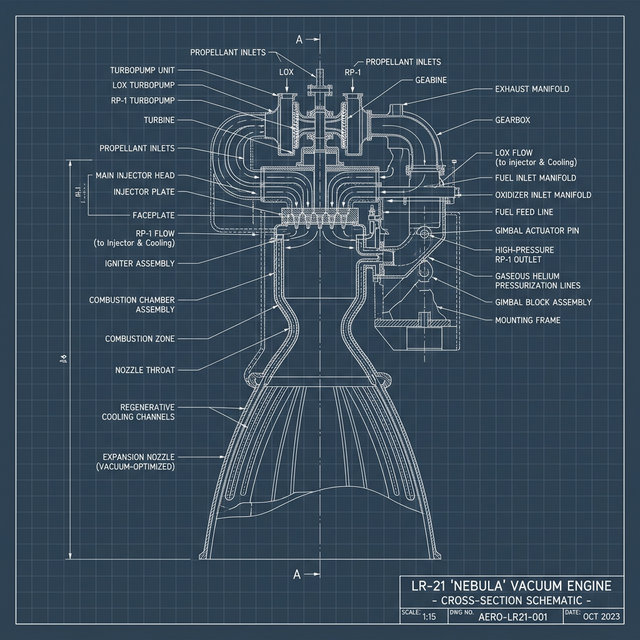 Fig 2. Cross-section schematic of a complex orbital rocket engine turbopump
assembly.
Fig 2. Cross-section schematic of a complex orbital rocket engine turbopump
assembly.
High Thrust, Low Efficiency: Solid Motors
Solid Rocket Boosters are essentially enormous, controlled pipe bombs. They consume solid propellant at terrifying, uncontrollable rates with abysmal fuel efficiency (Low Isp). However, they deliver millions of pounds of instantaneous thrust—the exact violent force required to punch a heavy vehicle through the densest bottom layers of Earth's atmosphere before being discarded.
High Efficiency, Low Thrust: Ion Thrusters
They operate exclusively in the vacuum of deep space, where gravity and aerodynamic drag are negligible. A traditional Ion thruster electrically accelerates Xenon gas. Its efficiency (High Isp) is unparalleled, but its physical thrust is so incredibly weak it feels like the weight of a sheet of notebook paper resting on your hand. It could never lift a rocket off Earth, but in the frictionless void, pushing softly for six months straight will ultimately carry you to Jupiter.
5 Orbit Means Going Sideways Fast
Spaceflight is rarely strictly vertical. While a launch vehicle must initially ascend straight up to pierce the thickest atmospheric drag (navigating peak aerodynamic stress, or Max-Q), it rapidly executes a programmed "gravity turn" to fly parallel to the curvature of the Earth.
Reaching altitude is relatively trivial; maintaining it is monumental. If you fly directly up 400km into space and cut the engines, gravity will immediately pull you back into the ocean in a parabolic ballistic arc. Achieving orbit requires accelerating horizontally to an astonishing 28,000 km/h (17,500 mph).
At terminal orbital velocity, gravity does not vanish. It is actively pulling the spacecraft downward every second. However, because you possess such immense lateral speed, the spherical surface of the Earth curves away from you at the exact same rate you fall toward it. Orbit is not zero-gravity; it is the state of falling infinitely and continually missing the ground. This perpetual free-fall is why astronauts inside the International Space Station appear to float.